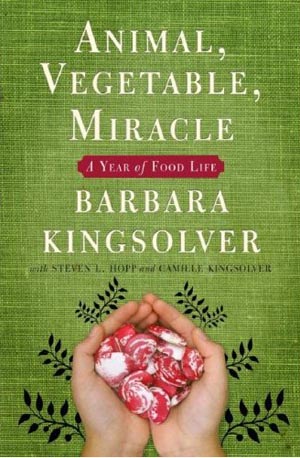
 Just recently I came across a treasure that I have not been able to put down. It's a simple book really, about food and the relationship we have with food, or should have with food. Our government has tried to control what and how we eat, this book is one womans way of bringing back the simplicity and joy food should bring to our homes and to our families. I want to share with you something from that book, but first let me set up what is happening. Barbara Kingsolver (the author) and her family took a trip and stopped to visit some dear friends, David and Elsie, that were farmers in Pennsylvania, it's a little long but well worth the reading....the following are Barbara's words....
"We sat in the dark until after midnight, out in the yard under the cherries, talking about the Farm Bill, our kids, religion, the future, books, writing. In his spare time (a concept I can hardly imagine for this man) David is a writer and editor of Farming Magazine, a small periodical on sustainable agriculture. We could have talked longer, but thought better of it. People might sometimes wish to sleep in, but cows never do.
In the morning I woke up in the upstairs bedroom aware of a breeze coming through the tall windows, sunlight washing white walls, a horse clop-clopping by on the road outside. I had the sensation of waking in another country, far from loud things.
Lily went out to the chicken coop to gather eggs, making herself right at home. We ate some for breakfast, along with the farm's astonishingly good oatmeal sweetened with strawberries and cream. This would be a twenty-dollar all-natural breakfast on the room service menu of some hotels. I pointed this out do David and Elsie----that many people think of such food as an upper-class privilege. David laughed . "We eat fancy food all right. Organic oatmeal, out of the same bin we feed our horses from!"
We packed up to leave, reminding one another of articles we meant to exchange. We vowed to come again, and hoped they'd come our way too, thought that is less likely, because they don't travel as much as we do. Nearly all their trips are limited by the stamina of the standardbred horses that draw their buggy. David and Elsie are Amish.
Before I had Amish friends, I imagined unbending constraints or categorical aversions to such things as cars (hybrid or otherwise). Like many people, I needed firsthand acquaintance to educate me out of religious bigotry. The Amish don't oppose technology on principle, only particular technologies they feel would change their lives for worse. I have sympathy for this position; a good many of us, in fact, might with we'd come around to it before so much noise got into our homes. As it was explained to me, the relationship of the Amish with their technology is to strive for what is "appropriate," making that designation case by case. When milking machines came up for discussion in David and Elsie's community, the dairy farmers pointed out that milking by hand involves repeatedly lifting eighty-pound milk cans, limiting the participation of smaller-framed women and children. Milking machines were voted in because they allow families to do this work together. For related reasons, most farmers in the community use tractors for occasional needs like pulling a large wagon or thresher (one tractor can thus handle the work on many farms). But for daily plowing and cultivatin, most prefer the quiet and pace of a team of Percherons or Belgians.
David summarizes his position on technology in one word: boundaries. "The workhorse places a limit on the size of our farms, and the standardbred horse-drawn buggy limits the distances we travel. This is basically what we need. This is what keeps our communities healthy." It makes perfect sense, of course, that limiting territory size can yield dividends in appreciation for what one already has, and the ability to manage it without debt. The surprise is to find whole communities gracefully accepting such boundaries, inside a nation that seems allergic to limitations, priding itself instead on the freedom to go as far as we want , as fast as we can, and buy until we run out of money---or longer, if we have credit cards.
Farmers like Elsie and David are a link between the past and the future. They've declined to participate in the modern century's paradigm of agriculture---and of family life, for that matter, as they place high value on nonmaterial things like intergenerational family bonds, natural aesthetics, and the pleasures of shared work. By restraining their consumptions an retaining skills from earlier generations of farmers, they are succeeding. When the present paradigm of extractive farming has run its course, I don't foresee crowds of people signing up for the plain wardrobe. But I do foresee them needing guidance on sustainable agriculture.
I realized this several years ago when David and Elsie came to our county to give an organic dairy workshop, at the request of dairy farmers here who were looking for new answers. It was a discouraged lot who attended the meeting, most of them nearly bankrupt, who'd spent their careers following modern dairy methods to the letter: growth hormones, antibiotics, mechanization. David is a deeply modest man, but the irony of the situation could not have been lost on him. There sat a group of hardworking farmers who'd watched their animals, land and accounts slide into ruin during the half-century since the USDA declared as its official policy, "Get big or get out."
And there sat their teacher, a farmer who'd stayed small. Small enough, anyway, he would never have to move through his cornfield too quickly to study the soil, or hear the birds answer daylight with their song."
As I sat and read this excerpt to my husband and son I surprisingly got teary eyed and I wasn't sure why. But as I've given it thought I've come to the conclusion that it's the simple life that I long for. A life where I take care of and live off the land the good Lord has given us, surrounded by my family as we work side by side. I desire to live in a community where we all take care of ourselves and work together and make decisions together that will benefit everyone. I'm tired of big government that is run by greedy men and women that want control of our lives, trying to keep us ignorant and uninformed about what is best for us.
I'm not very good with words so I am very thankful for people like Barbara Kingsolver that can put onto paper what is in my heart: simplicity, joy, family and becoming more self reliant. It's time we all learn these things, after all isn't that what the Lord told Adam to do in the beginning of time...to take care of his family and the land and to keep His commandments. What more do we need that what the Lord had provided for us?
Thursday, July 31, 2008
Animal, Vegetable, Miracle
Posted by Karlene at 5:48 AM
Subscribe to:
Post Comments (Atom)
2 comments:
I'm excited to read this book, Mom (I still need to go get it). I've decided that we need to try and take a trip down to the Amish country while you're here. I'm sure that I can have the energy to spend one day down there. Afterall, it is slower paced down there.
What a wonderful passage. I even bought a framed saying that says; "Simplify Living." I think that's why I am drawn to lighthouses. It was a hard life but such a beautifully simple life. For some it was a very isolated life so they had to grow gardens and work together.
Post a Comment